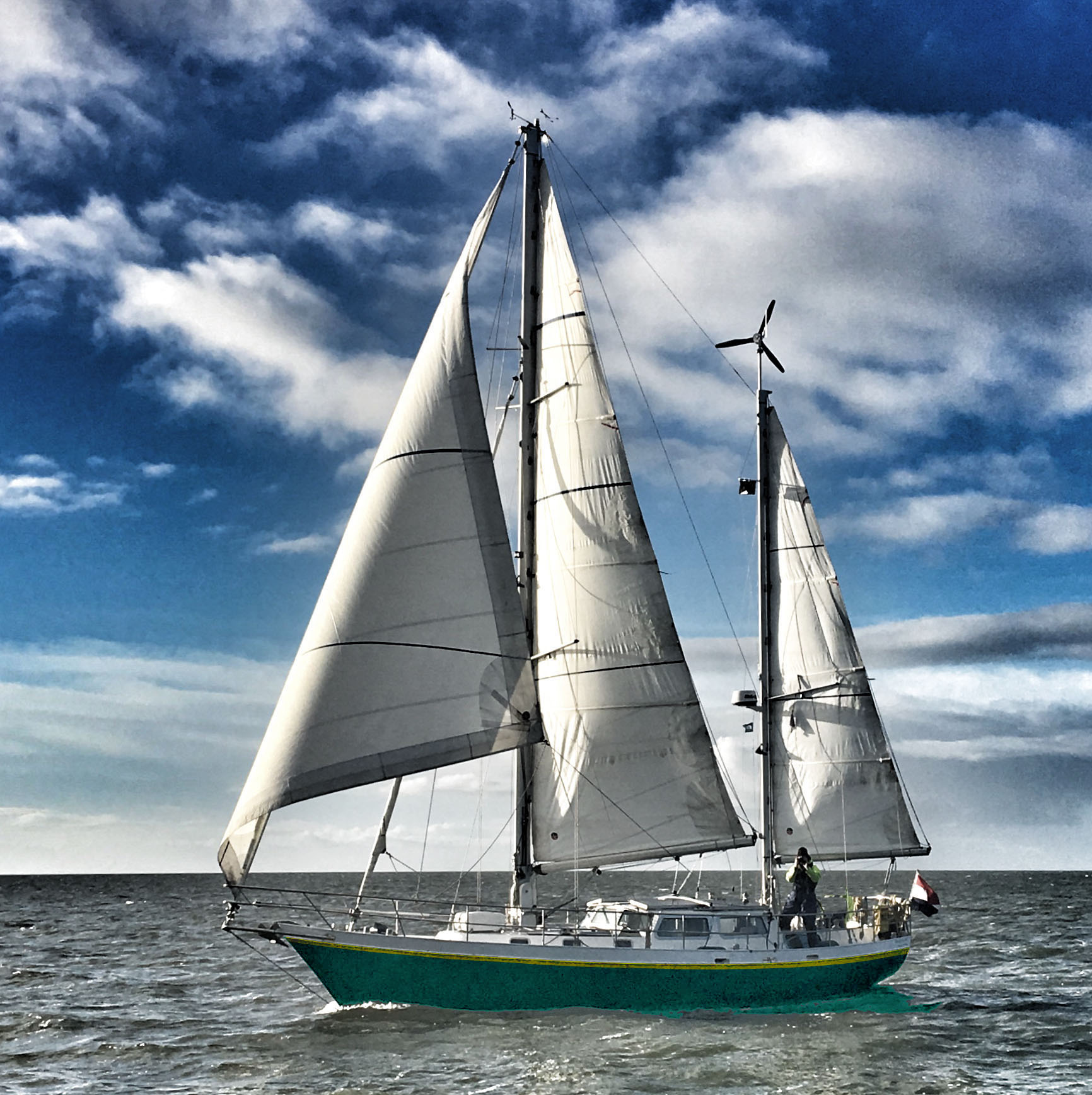
Let me introduce myself: I am Wim Winkelmolen, the creator and owner of New Energy.Today. I’m a senior electrical engineer and I live with my sweetheart Sher on our sailboat “Dione IV”.
We are often “off-grid” for long periods of time, during journeys at sea and at anchor, so it is a necessity to generate the energy we need from the sun and wind.
This is both where my inspiration for New Energy comes from and where developments in the field of renewable energy are implemented.
We have a lot of electric
appliances on board: induction cooker, oven, coffee maker, water kettle, 3 boilers for hot water, a washing machine and dryer, lots of electric tools, electric scooters, an electric outboard motor for the dinghy, computers, phones, all sorts of communication equipment, video screen, big fridge, freezer, audio system, numerous pumps, navigation equipment, auto pilot, water maker, lights, cameras, and fans. Really a lot!
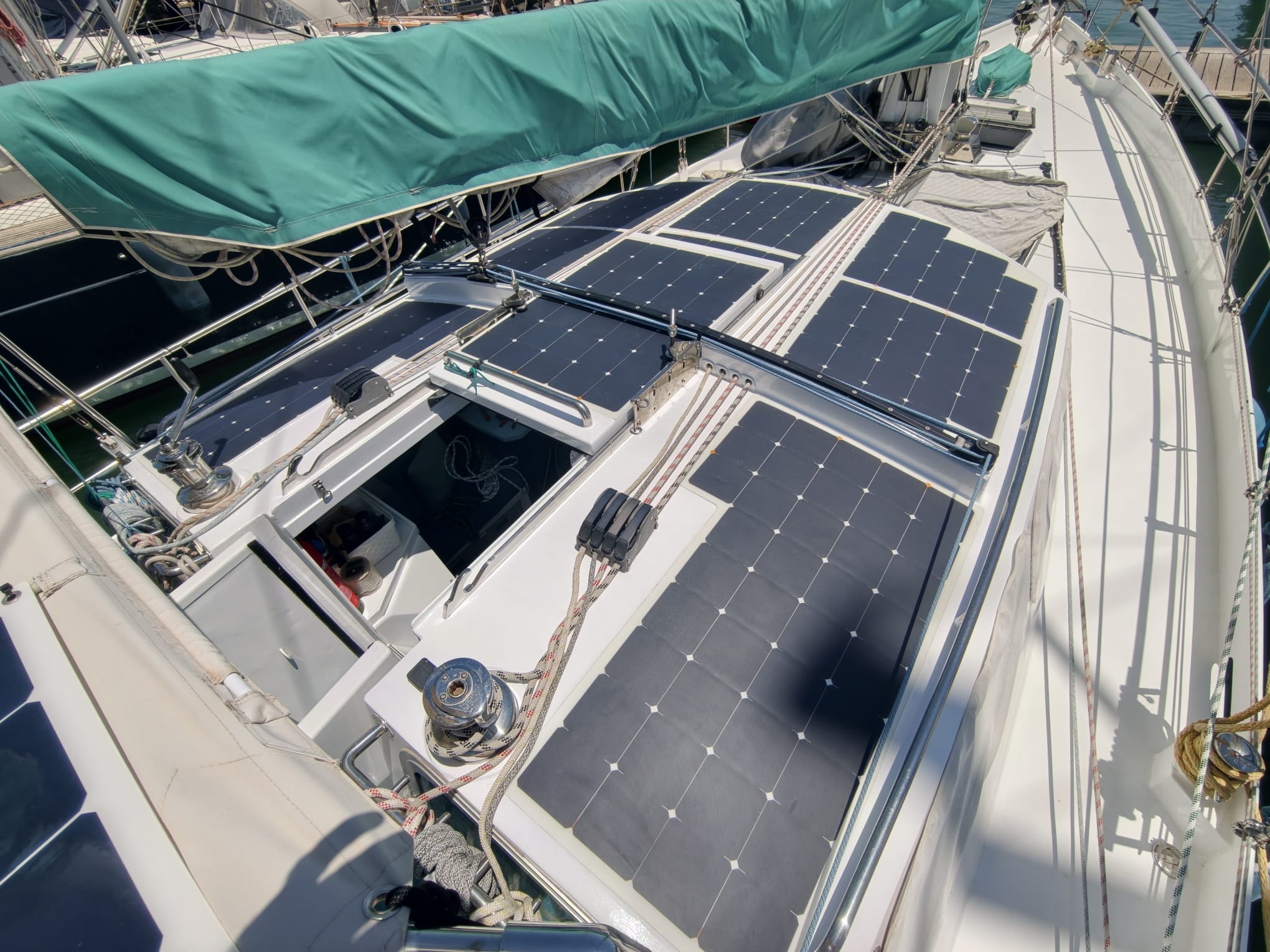
As you can read on the “Vision” page, the sun is our main source of energy. The greater part of our energy is generated by the 252 solar cells on our decksalon roof. Custom-made by Mito Solar. At mid-day, in the full sun, this generates about 850W of energy. These are divided in 3 strings (Starboard, Mid, Port) into 3 Victron MPPT’s.
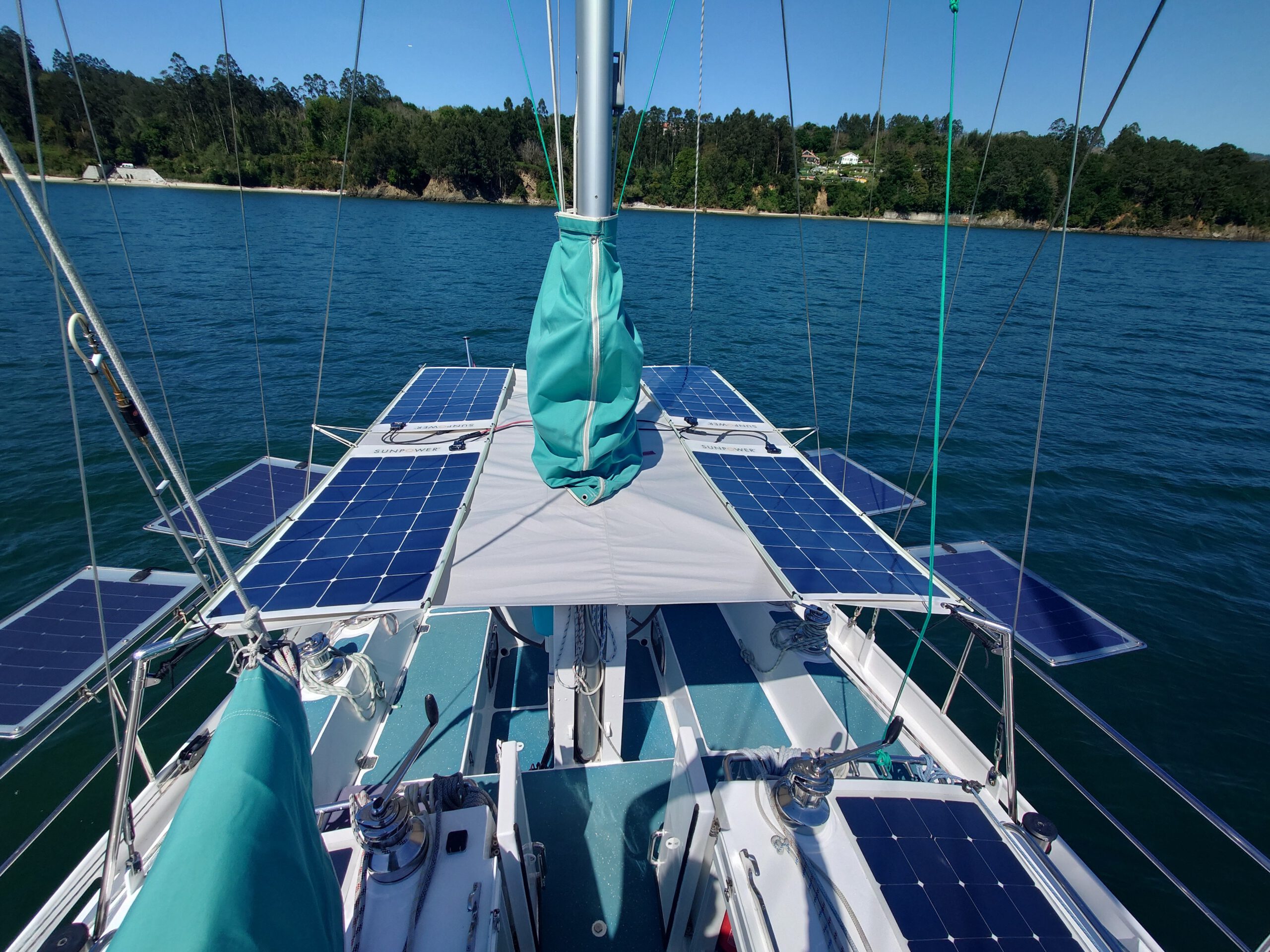
In addition to that, we have 4x 100W Sunpower panels mounted on our cockpit sun tent (into 1 Victron MPPT) and 4x 100W bi-facial panels made by Mito Solar on the railing (into 2 strings Port & Starboard to 2x Victron MPPT).
So, altogether, we have 1600Wp. Of course, there’s a lot of shade from the rigging during the day. At noon, on a sunny day, we see 800-1000W on average. The average yield is about 6-8kWh on a sunny day. Which is plenty for us, we use about 2-3 kWh/day.
In addition to the PV power we have our wind generator. It’s made by Istabreeze (Turkey) and it generates max 800W at a wind speed of 25 knots. Its power is converted to the 12v board system by a 3-phase rectifier into a Victron MPPT.
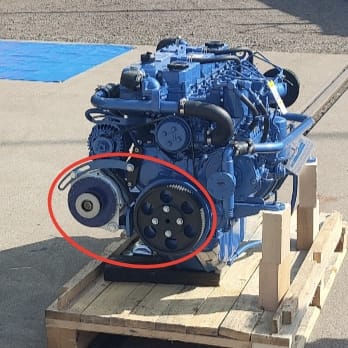
As a third source of energy we have a sturdy secondary alternator on the engine. 12v 130A driven by a 25mm toothed belt (on the photo the new engine, without the belt yet). In practice, this alternator is always switched off because we have plenty of solar power.
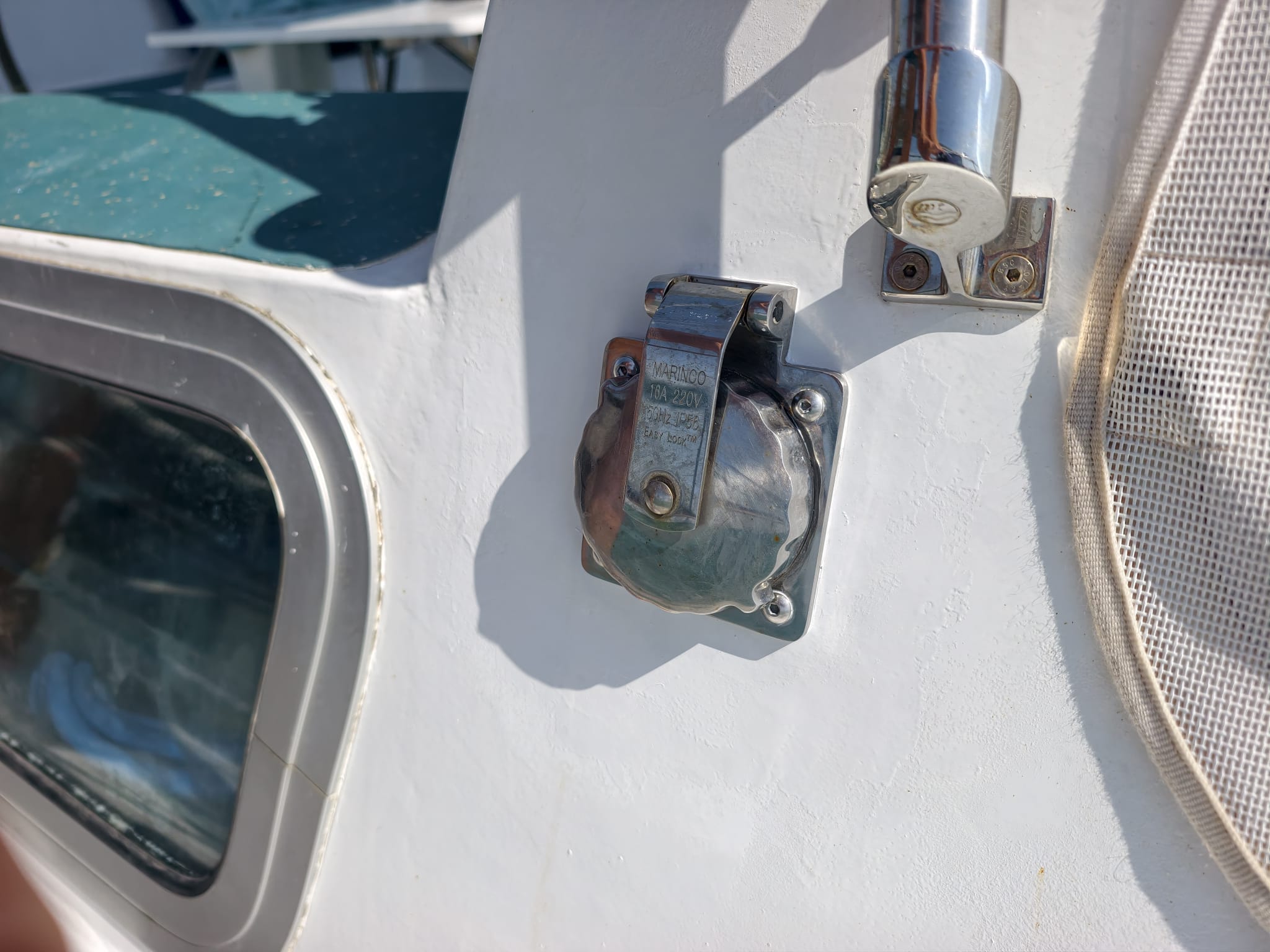
And the fourth source of energy is the shore power. Rarely used.
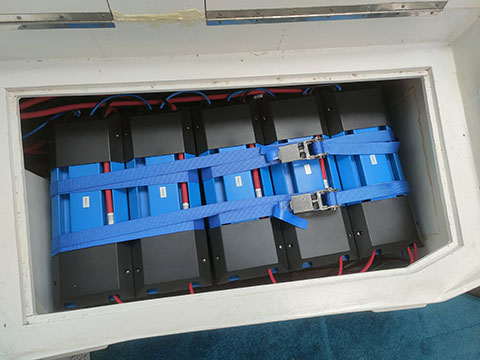
That power is stored in our 5x 12,8v 210Ah (13,5kWh) MG Energy battery bank. These 5 cuties are positioned in a small couch in our salon and weigh only 110kg altogether.
MG Energy manufactures the world’s best lithium batteries and the world’s best battery management systems.
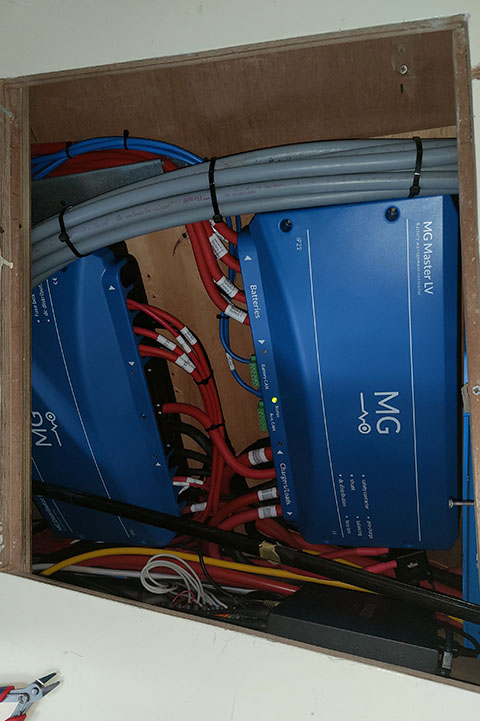
Under our bed, the MG Energy Battery Management System and Distributor take care of the safety and distribute the energy over the boat.
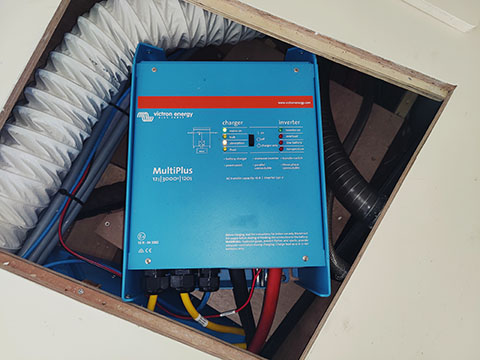
The Victron 3k MultiPlus inverter/charger supplies our 230v board system.
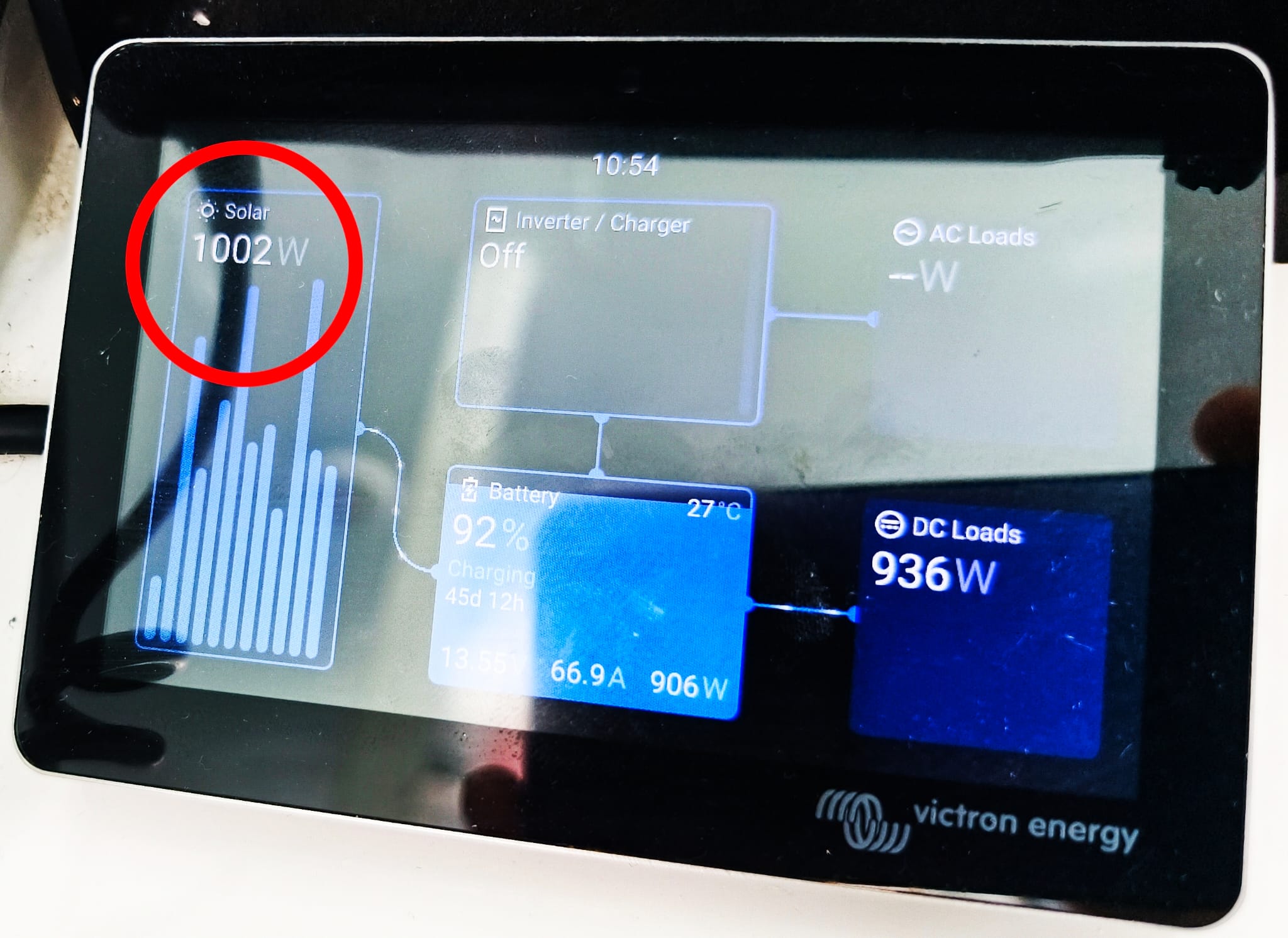
The Victron Cerbo takes care of all the monitoring & control.
For redundancy, we have a second Victron inverter/charger (24v 1600W) connected to the bow thruster battery (1x MG Energy 25,8v 280Ah, 7,2 kWh).
All these systems provide us with plenty of energy to be fully self-sufficient. We can sail and we can stay at anchor for unlimited periods of time. We don’t have to plug in shore power when we’re in a marina and we don’t need to watch how much power we’re using.
It demonstrates my vision is right: the sun provides most of our energy. Our daily consumption is fully covered.
It also proves another part of my vision: that we will still need some fossil energy. Namely, for our propulsion. We have a diesel engine. When I had to replace the engine in 2022 I considered installing an electric motor. One of my suppliers even offered an electric motor free of charge, as a test and marketing project! But… Dione IV is a heavy lady. She needs about 25kW to maintain cruising speed when there’s no wind. And she needs a lot more (we estimated 80kW) to push her against strong winds, high waves or strong current (the 55kW of the old diesel engine was sometimes not enough). An 80kW motor is a high voltage device (360-420v), the current would be crazy high at 48v. So that needs a separate, big, high voltage battery bank. Impossible to charge that with our amount of solar energy so that needs a big diesel generator (at least 25kW, to sustain cruising speed). There is no room on the boat for all of that and it would add about 2 tons of weight. And it would probably consume even more diesel than a conventional engine, due to all the conversion losses. So, that plan was out of the question… I’m pretty much convinced that in my lifetime, in this boat, there will be no alternative for the diesel engine 🙄. But, we use our sails as much as we can and use the engine as less as we can! ⛵